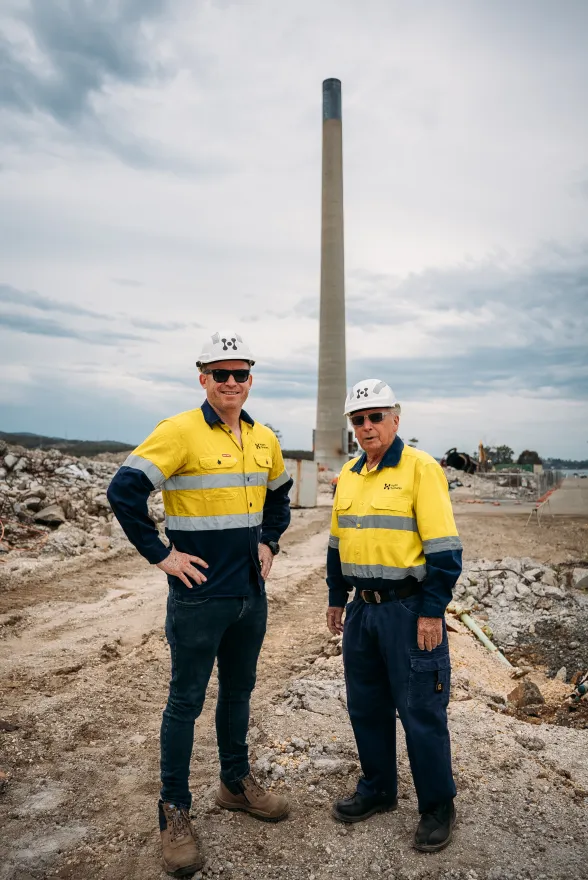



Bell Bay’s final chapter: a father and son, and a power station that powered generations
Now, after months of carefully planned controlled explosions and demolition works, the station is nearing the end of its physical life. In mid-January, the final major controlled explosion will bring down the station’s iconic stack, marking the close of a chapter not just for Hydro Tasmania, but for the people whose lives were shaped by the place.
Among them are two family members with the same name but two very different careers, united by memories of one power station – Hydro Tasmania Production Manager Chris Ashley, who spent over three decades working at Bell Bay, and his son Chris, who also works at Hydro Tasmania.
Built for when Tasmania needed it most
Constructed between 1971 and 1974, Bell Bay was an oil-fired thermal power station designed to operate when water levels were low and Tasmania’s hydropower stations needed backup. Heavy fuel oil was shipped up the Tamar River by tanker and unloaded at the site, sometimes taking between 12 and 18 hours.
The station housed two Parsons 120-megawatt steam turbine generators, built in England, along with their associated boilers and ancillary equipment. In 2003, Bell Bay was converted from oil to gas, extending its working life until it ceased operation in 2009.
“When it was running, you knew Tasmania needed it,” says Chris, who worked at the site as a Production Supervisor. “If there hadn’t been much rain and the dams were getting low, Bell Bay would fire up. It was there to do a job, and it did it well.”
A career built on experience and people
Chris moved to Tasmania in 1991 from Western Australia, after working on power stations in both Perth and Papua New Guinea. Bell Bay felt immediately familiar.
“The first time I walked in, I remember thinking I’d been here before,” he says. “I am pretty sure the architect was the same as a station I’d worked at in PNG. The layout, the feel of the place, it all made sense straight away.”
As production supervisor, he was responsible for making sure the machinery operated effectively. It was a hands-on role, with very little computerisation.
“If something went wrong, you fixed it with your hands. That’s what I loved about it,” says Chris.
But it was the people who left the biggest impression.
“My team were fabulous. Some of the best managers I’ve ever had worked at Bell Bay. People stayed for a long time, and that says a lot.”
He still remembers his first Christmas in Tasmania, unloading oil from a tanker that had arrived that day.
“That was my welcome to Tassie,” he laughs. “Straight into it."
Etched into steel
One of Bell Bay’s most recognisable features is the 110-metre stack, which has dominated the skyline for decades. Maintaining it was no small task.
“Every few years the team had to repaint it and do inspections,” Chris recalls. “It would take a day and a half just to connect all the ladders. They linked them on top of each other to climb the tower.”
He was once tempted to climb it himself, after a staff member painted Adelaide Football Club colours near the top.
“I was told I could go up and change them to West Coast colours if I wanted. I decided I was happy with them staying as they were.”
At the top of the stack sits a stainless-steel ring, installed around 15 years ago. The manager at the time etched the names of all the staff working onsite into it. That ring, along with the stack, will come down in the final major controlled explosion.
Childhood memories and a new generation
Back in the 1990s, when the station was not running, Chris would sometimes bring his son onsite.
“I was about eight when we moved to Tasmania,” his son Chris says. “I remember being at Bell Bay with dad, running around and thinking it was the coolest place.”
One memory stands out clearly.
“I got to go down to the jetty once when a tanker was in. I can still picture it. Sometimes we’d go fishing too.”
As a young adult, the younger Chris left Tasmania to join the Royal Australian Air Force, later building a career in IT and consulting. After returning to Tasmania to start a family and enjoy the lifestyle again, an opportunity with Hydro Tasmania came up.
“I wasn’t necessarily looking for a job at Hydro Tasmania but I knew how much dad loved working at Bell Bay,” says Chris.
“Any employer that keeps someone happy for more than 30 years must be doing something right.”
Five years on, he is still with Hydro Tasmania, now working as an IT Project Lead and managing various IT teams.
“They invest in their people. I’ve been lucky enough to visit most of the power stations across the state. I get to travel and see how the whole system works. It’s a very different job to dad’s, but it shows how working at Hydro Tasmania can span generations.”
A careful goodbye
Hydro Tasmania is now clearing the Bell Bay site alongside specialist contractors McMahon Services Australia, which was also engaged to manage asbestos and hazardous material at the site. This has been handled in accordance with Work, Health and Safety regulations, guidelines and safe work practices, including oversight from an independent asbestos assessor.
Chris remains involved in the project, assisting with the decommissioning process.
“I know the site inside out and I understand why it has to come down. A lot of work went into managing and removing it safely.”
When the project is complete, the site will be left clean, with no evident hazardous materials remaining. Where practical, materials have been recycled.
The day Bell Bay stopped operating in 2009 still stands out.
“It was a sad day for all of us,” Chris says. “But I’m proud of what we did there.”
The final moment
January’s controlled explosion will be the final big one, bringing down the last major structure and closing the physical chapter of Bell Bay Power Station.
For father and son, it is both an ending and a reminder.
“Bell Bay shaped a big part of my working life and now my son has his own story with Hydro Tasmania. That means a lot,” says Chris.
His son agrees.
“The station might be coming down, but what it represents doesn’t disappear. It powered Tasmania when it needed it, and it powered a lot of careers too.”
As Bell Bay fades from the skyline, its legacy lives on through the people who built it, ran it, and grew up in its shadow.